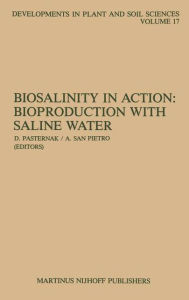
Biosalinity in Action: Bioproduktion mit Salzwasser von D. Pasternak (Englisch)
- nieuw boekISBN: 9789024731596
Biosalinity in Action: Bioproduction with Saline Water. Subtitle Bioproduction with Saline Water. Short Title BIOSALINITY IN ACTION BIOPRODU. - Adaptation to salinity at the plant cell le… Meer...
Biosalinity in Action: Bioproduction with Saline Water. Subtitle Bioproduction with Saline Water. Short Title BIOSALINITY IN ACTION BIOPRODU. - Adaptation to salinity at the plant cell level. - Physiology of halophytes. The Nile on eBay FREE SHIPPING UK WIDE Biosalinity in Action: Bioproduction with Saline Water by D. Pasternak, Anthony San Pietro This new, even radical, approach to salinity was clearly enunciated in the book he edited and most appropriately entitled 'Salinity and Aridity: New Approaches to Old Problems' (1966). FORMATHardcover LANGUAGEEnglish CONDITIONBrand New Publisher Description Historically, scientists and laymen have regarded salinity as a hazar dous, detrimental phenomenon. This negative view was a principal reason for the lack of agricultural development of most arid and semi arid zones of the world where the major sources of water for biological production are saline. The late Hugo Boyko was probably the first scientist in recent times to challenge this commonly held, pessimistic view of salinity. His research in Israel indicated that many plants can be irrigated with saline water, even at seawater strength, if they are in sandy soil - a technique that could open much barren land to agriculture. This new, even radical, approach to salinity was clearly enunciated in the book he edited and most appropriately entitled 'Salinity and Aridity: New Approaches to Old Problems' (1966). A decade later, three members of the United States National Science Foundation (NSF), Lewis Mayfield, James Aller and Oskar Zaborsky, formulated the 'Biosaline Concept'; namely, that poor soils, high solar insolation and saline water, which prevail in arid lands, should be viewed as useful resources rather than as disadvantages, and that these resources can be used for non-traditional production of food, fuels and chemicals. The First International Workshop on Biosaline Research was con vened at Kiawah Island, South Carolina, in 1977 by A. San Pietro. Table of Contents Section 1: Mechanisms of salt tolerance in algae and terrestrial plants.- Adaptation to salinity at the plant cell level.- Some mechanisms of salt tolerance in crop plants.- Physiology of halophytes.- The cost to plants of different strategies of adaptation to stress and the alleviation of stress by increasing assimilation.- Mechanisms of response to salinity in halotolerant microalgae.- The effect of compatible solutes on proteins.- Section 2: Production of micro and macroalgae with saline water.- Blue-green algae (cyanobacteria): prospects and perspectives.- Cyanobacterial biomass production in saline media.- The potential of production of sulfated polysaccharides from Porphyridium.- Problems in developing the biotechnology of algal biomass production.- Macroalgae (seaweeds): industrial resources and their utilization.- Outdoor cultivation of sea vegetables.- Section 3: Crop production with saline water.- Salt-tolerant crops: origins, development and prospects of the concept.- Genetics of salt tolerance in higher plants: theoretical and practical considerations.- Principles and strategies in breeding for higher salt tolerance.- Selection and breeding for salinity tolerance in vitro.- Crop production and management under saline conditions.- Crop tolerance to saline sprinkling water.- Fertilization management of crops irrigated with saline water.- Effect of salinity on quality of various agricultural crops.- Section 4: Seawater agriculture.- Agricultural production of halophytes irrigated with seawater.- Halophytic crops for cultivation at seawater salinity.- Developing the seawater agriculture concept.- Section 5: Mariculture.- The present situation and problems of mariculture in Japan. Long Description Historically, scientists and laymen have regarded salinity as a hazar Details ISBN9024731593 Publisher Springer Language English ISBN-10 9024731593 ISBN-13 9789024731596 Media Book Format Hardcover DEWEY 570 Series Number 17 Year 1985 Publication Date 1985-11-30 Imprint Kluwer Academic Publishers Subtitle Bioproduction with Saline Water Place of Publication Dordrecht Country of Publication Netherlands Edited by Anthony San Pietro Short Title BIOSALINITY IN ACTION BIOPRODU Pages 369 DOI 10.1023/b125072;10.1007/978-94-009-5111-2 UK Release Date 1985-11-30 Illustrations XIX, 369 p. Author Anthony San Pietro Edition Description 1985 ed. Series Developments in Plant and Soil Sciences Edition 1985th Alternative 9789401087599 Audience Postgraduate, Research & Scholarly We've got thisAt The Nile, if you're looking for it, we've got it.With fast shipping, low prices, friendly service and well over a million items - you're bound to find what you want, at a price you'll love! 30 DAY RETURN POLICYNo questions asked, 30 day returns! FREE DELIVERYNo matter where you are in the UK, delivery is free. SECURE PAYMENTPeace of mind by paying through PayPal and eBay Buyer Protection TheNile_Item_ID:158880944; , von Profianbieter, Neu, Festpreisangebot, [LT: FixedPrice], ISBN-13: 9789024731596, Book Title: Biosalinity in Action: Bioproduction with Saline Water<
| | ebay.dethe_nile_uk_store 98.7, Zahlungsarten: Bar, Paypal, APPLE_PAY, Kreditkarte, Visa, Mastercard, DINERS_CLUB, Priority Listing. Verzendingskosten:Versand zum Fixpreis, [SHT: Standardversand], 450** Ohio, [TO: Weltweit] (EUR 15.22) Details... |
(*) Uitverkocht betekent dat het boek is momenteel niet beschikbaar op elk van de bijbehorende platforms we zoeken.

D. Pasternak:Biosalinity in Action: Bioproduction with Saline Water (Hardcover)
- gebonden uitgave, pocketboek 1985, ISBN: 9024731593
[EAN: 9789024731596], Neubuch, [PU: Springer, Dordrecht], Hardcover. Historically, scientists and laymen have regarded salinity as a hazar dous, detrimental phenomenon. This negative view… Meer...
[EAN: 9789024731596], Neubuch, [PU: Springer, Dordrecht], Hardcover. Historically, scientists and laymen have regarded salinity as a hazar dous, detrimental phenomenon. This negative view was a principal reason for the lack of agricultural development of most arid and semi arid zones of the world where the major sources of water for biological production are saline. The late Hugo Boyko was probably the first scientist in recent times to challenge this commonly held, pessimistic view of salinity. His research in Israel indicated that many plants can be irrigated with saline water, even at seawater strength, if they are in sandy soil - a technique that could open much barren land to agriculture. This new, even radical, approach to salinity was clearly enunciated in the book he edited and most appropriately entitled 'Salinity and Aridity: New Approaches to Old Problems' (1966). A decade later, three members of the United States National Science Foundation (NSF), Lewis Mayfield, James Aller and Oskar Zaborsky, formulated the 'Biosaline Concept'; namely, that poor soils, high solar insolation and saline water, which prevail in arid lands, should be viewed as useful resources rather than as disadvantages, and that these resources can be used for non-traditional production of food, fuels and chemicals. The First International Workshop on Biosaline Research was con vened at Kiawah Island, South Carolina, in 1977 by A. San Pietro. This new, even radical, approach to salinity was clearly enunciated in the book he edited and most appropriately entitled 'Salinity and Aridity: New Approaches to Old Problems' (1966). Shipping may be from our Sydney, NSW warehouse or from our UK or US warehouse, depending on stock availability., Books<
| | AbeBooks.deAussieBookSeller, Truganina, VIC, Australia [52402892] [Rating: 5 (von 5)] NEW BOOK. Verzendingskosten: EUR 35.06 Details... |
(*) Uitverkocht betekent dat het boek is momenteel niet beschikbaar op elk van de bijbehorende platforms we zoeken.

MONSTER
D. Pasternak:Biosalinity in Action: Bioproduction with Saline Water (Hardcover)
- gebonden uitgave, pocketboek 1985, ISBN: 9024731593
[EAN: 9789024731596], Neubuch, [PU: Springer, Dordrecht], Hardcover. Historically, scientists and laymen have regarded salinity as a hazar dous, detrimental phenomenon. This negative view… Meer...
[EAN: 9789024731596], Neubuch, [PU: Springer, Dordrecht], Hardcover. Historically, scientists and laymen have regarded salinity as a hazar dous, detrimental phenomenon. This negative view was a principal reason for the lack of agricultural development of most arid and semi arid zones of the world where the major sources of water for biological production are saline. The late Hugo Boyko was probably the first scientist in recent times to challenge this commonly held, pessimistic view of salinity. His research in Israel indicated that many plants can be irrigated with saline water, even at seawater strength, if they are in sandy soil - a technique that could open much barren land to agriculture. This new, even radical, approach to salinity was clearly enunciated in the book he edited and most appropriately entitled 'Salinity and Aridity: New Approaches to Old Problems' (1966). A decade later, three members of the United States National Science Foundation (NSF), Lewis Mayfield, James Aller and Oskar Zaborsky, formulated the 'Biosaline Concept'; namely, that poor soils, high solar insolation and saline water, which prevail in arid lands, should be viewed as useful resources rather than as disadvantages, and that these resources can be used for non-traditional production of food, fuels and chemicals. The First International Workshop on Biosaline Research was con vened at Kiawah Island, South Carolina, in 1977 by A. San Pietro. This new, even radical, approach to salinity was clearly enunciated in the book he edited and most appropriately entitled 'Salinity and Aridity: New Approaches to Old Problems' (1966). Shipping may be from multiple locations in the US or from the UK, depending on stock availability., Books<
| | AbeBooks.deGrand Eagle Retail, Wilmington, DE, U.S.A. [50531827] [Rating: 5 (von 5)] NEW BOOK. Verzendingskosten: EUR 70.99 Details... |
(*) Uitverkocht betekent dat het boek is momenteel niet beschikbaar op elk van de bijbehorende platforms we zoeken.

Anthony San Pietro:Biosalinity in Action: Bioproduction with Saline Water
- gebonden uitgave, pocketboek 1985, ISBN: 9024731593
[EAN: 9789024731596], Neubuch, [PU: Springer Netherlands Nov 1985], BOTANIK; PFLANZE / PHYSIOLOGIE; PHYSIOLOGIE (PFLANZE); ASSIMILAT; POLYSACCHARID; POLYSACCHARIDE; ALGAE; BIOTECHNOLOGY; … Meer...
[EAN: 9789024731596], Neubuch, [PU: Springer Netherlands Nov 1985], BOTANIK; PFLANZE / PHYSIOLOGIE; PHYSIOLOGIE (PFLANZE); ASSIMILAT; POLYSACCHARID; POLYSACCHARIDE; ALGAE; BIOTECHNOLOGY; PHYSIOLOGY; PROTEINS; QUALITY, This item is printed on demand - it takes 3-4 days longer - Neuware -Historically, scientists and laymen have regarded salinity as a hazar dous, detrimental phenomenon. This negative view was a principal reason for the lack of agricultural development of most arid and semi arid zones of the world where the major sources of water for biological production are saline. The late Hugo Boyko was probably the first scientist in recent times to challenge this commonly held, pessimistic view of salinity. His research in Israel indicated that many plants can be irrigated with saline water, even at seawater strength, if they are in sandy soil - a technique that could open much barren land to agriculture. This new, even radical, approach to salinity was clearly enunciated in the book he edited and most appropriately entitled 'Salinity and Aridity: New Approaches to Old Problems' (1966). A decade later, three members of the United States National Science Foundation (NSF), Lewis Mayfield, James Aller and Oskar Zaborsky, formulated the 'Biosaline Concept'; namely, that poor soils, high solar insolation and saline water, which prevail in arid lands, should be viewed as useful resources rather than as disadvantages, and that these resources can be used for non-traditional production of food, fuels and chemicals. The First International Workshop on Biosaline Research was con vened at Kiawah Island, South Carolina, in 1977 by A. San Pietro. 394 pp. Englisch, Books<
| | AbeBooks.deBuchWeltWeit Ludwig Meier e.K., Bergisch Gladbach, Germany [57449362] [Rating: 5 (von 5)] NEW BOOK. Verzendingskosten:Versandkostenfrei. (EUR 0.00) Details... |
(*) Uitverkocht betekent dat het boek is momenteel niet beschikbaar op elk van de bijbehorende platforms we zoeken.

MONSTER
Anthony San Pietro:Biosalinity in Action: Bioproduction with Saline Water
- nieuw boek ISBN: 9789024731596
[ED: Buch], [PU: Springer Netherlands, Springer Netherlands], Neuware - Historically, scientists and laymen have regarded salinity as a hazar dous, detrimental phenomenon. This negative v… Meer...
[ED: Buch], [PU: Springer Netherlands, Springer Netherlands], Neuware - Historically, scientists and laymen have regarded salinity as a hazar dous, detrimental phenomenon. This negative view was a principal reason for the lack of agricultural development of most arid and semi arid zones of the world where the major sources of water for biological production are saline. The late Hugo Boyko was probably the first scientist in recent times to challenge this commonly held, pessimistic view of salinity. His research in Israel indicated that many plants can be irrigated with saline water, even at seawater strength, if they are in sandy soil - a technique that could open much barren land to agriculture. This new, even radical, approach to salinity was clearly enunciated in the book he edited and most appropriately entitled 'Salinity and Aridity: New Approaches to Old Problems' (1966). A decade later, three members of the United States National Science Foundation (NSF), Lewis Mayfield, James Aller and Oskar Zaborsky, formulated the 'Biosaline Concept'; namely, that poor soils, high solar insolation and saline water, which prevail in arid lands, should be viewed as useful resources rather than as disadvantages, and that these resources can be used for non-traditional production of food, fuels and chemicals. The First International Workshop on Biosaline Research was con vened at Kiawah Island, South Carolina, in 1977 by A. San Pietro., DE, [SC: 0.00], Neuware, gewerbliches Angebot, 241x160x26 mm, 394, [GW: 755g], Banküberweisung, PayPal, Skrill/Moneybookers, Selbstabholung und Barzahlung, Offene Rechnung (Vorkasse vorbehalten)<
| | booklooker.deBuchhandlung Hoffmann Verzendingskosten:Versandkostenfrei, Versand nach Deutschland. (EUR 0.00) Details... |
(*) Uitverkocht betekent dat het boek is momenteel niet beschikbaar op elk van de bijbehorende platforms we zoeken.